


DATE: 19 - 25 October, 2026
SURFACE: Hard
PRIZE MONEY: €757,320
FIELD SIZE: 28
2025 CHAMPION: Ugo Humbert
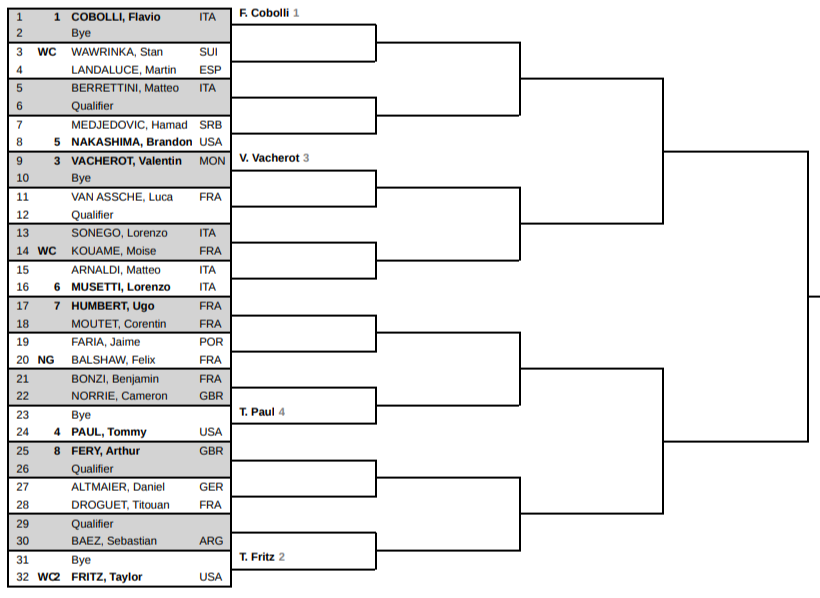
Seeds and Draw
1 Cobolli, Flavio
2 Fritz, Taylor
3 Vacherot, Valentin
4 Paul, Tommy
5 Nakashima, Brandon
6 Musetti, Lorenzo
7 Humbert, Ugo
8 Fery, Arthur
The Tournament
The Grand Prix Auvergne-Rhône-Alpes is an ATP 250 tournament making its debut in Lyon in 2026, bringing another major international tennis event to one of France's most important sporting and cultural centres. Held from 19–25 October, the tournament is played on indoor hard courts and forms part of the ATP Tour's European autumn schedule.
Although new to Lyon, the tournament has a distinguished history dating back to 1993. Previously known as the Marseille Open 13 Provence, it was staged in Marseille for 33 editions before relocating to Lyon for the 2026 season. The move marks a new chapter for an established French tennis event, preserving its ATP 250 status while introducing it to a different city and audience.
The tournament's origins are closely associated with former French professional Jean-François Caujolle, who played a leading role in establishing a tour-level competition in his hometown of Marseille. Over more than three decades, the event developed a reputation for entertaining indoor tennis and produced numerous memorable champions.
French players enjoyed particular success throughout its history. Guy Forget claimed the title in 1996, followed by Fabrice Santoro in 1999, Arnaud Clément in 2006 and Gilles Simon in 2007 and 2015. Jo-Wilfried Tsonga became one of the tournament's most successful competitors, winning three titles in 2009, 2013 and 2017, while Michaël Llodra triumphed in 2011. More recently, Ugo Humbert captured consecutive titles in 2024 and 2025, providing a fitting conclusion to the tournament's Marseille era.
Played during the closing weeks of the ATP season, the Grand Prix Auvergne-Rhône-Alpes offers players an important opportunity to collect ranking points and build momentum ahead of the final tournaments of the year. Its indoor hard courts favour precise serving, attacking tennis and quick reactions, promising competitive matches throughout the week.
As one of four French tournaments on the ATP Tour calendar, the event continues France's longstanding tradition of hosting elite professional tennis. Its arrival in Lyon combines an established sporting heritage with a new setting, creating an exciting addition to the city's international events programme.
Lyon
Situated in east-central France at the meeting point of the Rhône and Saône rivers, Lyon is one of the country's most historic and culturally significant cities. The capital of the Auvergne-Rhône-Alpes region, it combines more than two thousand years of history with a thriving modern economy, celebrated culinary traditions and a vibrant sporting culture.

Kalpak Travel, CC BY 2.0 <https://creativecommons.org/licenses/by/2.0>, via Wikimedia Commons
Founded by the Romans in 43 BC as Lugdunum, Lyon became an important administrative and commercial centre of Roman Gaul. Its remarkable heritage remains visible throughout the city, particularly in the historic districts of Vieux Lyon, Fourvière and the Presqu'île, which form part of a UNESCO World Heritage Site. Narrow Renaissance streets, elegant squares and distinctive passageways known as traboules offer visitors a fascinating glimpse into the city's past.

Benoît Prieur, CC0, via Wikimedia Commons
Overlooking Lyon from Fourvière Hill is the magnificent Basilica of Notre-Dame de Fourvière, one of the city's most recognisable landmarks. Nearby, the ancient Roman theatres reflect Lyon's classical origins, while the riverside promenades provide attractive views of the city's historic architecture and surrounding hills.

Dennis G. Jarvis, CC BY-SA 2.0 <https://creativecommons.org/licenses/by-sa/2.0>, via Wikimedia Commons
Lyon is particularly famous for its gastronomy and is widely regarded as one of France's great culinary capitals. Traditional restaurants known as bouchons serve regional specialities, while the city's markets, bakeries and contemporary dining establishments celebrate the exceptional produce of the surrounding Rhône Valley and Burgundy regions.
The city also has a strong association with innovation and the arts. Brothers Auguste and Louis Lumière, pioneers of early cinema, developed their cinematographic work in Lyon, and the Institut Lumière continues to celebrate their contribution to film history. Modern Lyon is equally recognised for its universities, research institutions, business districts and lively cultural festivals.
Sport plays an important role in the city's identity, with internationally recognised football, rugby and basketball teams contributing to its reputation as a major sporting destination. The arrival of the Grand Prix Auvergne-Rhône-Alpes in 2026 further strengthens Lyon's position on the international sporting calendar.
For tennis supporters visiting the tournament, Lyon offers an exceptional combination of historic landmarks, riverside scenery, world-renowned cuisine and contemporary French culture, making it an appealing destination both on and off the court.
Tourism
SURFACE: Hard
PRIZE MONEY: €757,320
FIELD SIZE: 28
2025 CHAMPION: Ugo Humbert
Seeds and Draw
1 Cobolli, Flavio
2 Fritz, Taylor
3 Vacherot, Valentin
4 Paul, Tommy
5 Nakashima, Brandon
6 Musetti, Lorenzo
7 Humbert, Ugo
8 Fery, Arthur
The Tournament
The Grand Prix Auvergne-Rhône-Alpes is an ATP 250 tournament making its debut in Lyon in 2026, bringing another major international tennis event to one of France's most important sporting and cultural centres. Held from 19–25 October, the tournament is played on indoor hard courts and forms part of the ATP Tour's European autumn schedule.
Although new to Lyon, the tournament has a distinguished history dating back to 1993. Previously known as the Marseille Open 13 Provence, it was staged in Marseille for 33 editions before relocating to Lyon for the 2026 season. The move marks a new chapter for an established French tennis event, preserving its ATP 250 status while introducing it to a different city and audience.
The tournament's origins are closely associated with former French professional Jean-François Caujolle, who played a leading role in establishing a tour-level competition in his hometown of Marseille. Over more than three decades, the event developed a reputation for entertaining indoor tennis and produced numerous memorable champions.
French players enjoyed particular success throughout its history. Guy Forget claimed the title in 1996, followed by Fabrice Santoro in 1999, Arnaud Clément in 2006 and Gilles Simon in 2007 and 2015. Jo-Wilfried Tsonga became one of the tournament's most successful competitors, winning three titles in 2009, 2013 and 2017, while Michaël Llodra triumphed in 2011. More recently, Ugo Humbert captured consecutive titles in 2024 and 2025, providing a fitting conclusion to the tournament's Marseille era.
Played during the closing weeks of the ATP season, the Grand Prix Auvergne-Rhône-Alpes offers players an important opportunity to collect ranking points and build momentum ahead of the final tournaments of the year. Its indoor hard courts favour precise serving, attacking tennis and quick reactions, promising competitive matches throughout the week.
As one of four French tournaments on the ATP Tour calendar, the event continues France's longstanding tradition of hosting elite professional tennis. Its arrival in Lyon combines an established sporting heritage with a new setting, creating an exciting addition to the city's international events programme.
Lyon
Situated in east-central France at the meeting point of the Rhône and Saône rivers, Lyon is one of the country's most historic and culturally significant cities. The capital of the Auvergne-Rhône-Alpes region, it combines more than two thousand years of history with a thriving modern economy, celebrated culinary traditions and a vibrant sporting culture.
Kalpak Travel, CC BY 2.0 <https://creativecommons.org/licenses/by/2.0>, via Wikimedia Commons
Founded by the Romans in 43 BC as Lugdunum, Lyon became an important administrative and commercial centre of Roman Gaul. Its remarkable heritage remains visible throughout the city, particularly in the historic districts of Vieux Lyon, Fourvière and the Presqu'île, which form part of a UNESCO World Heritage Site. Narrow Renaissance streets, elegant squares and distinctive passageways known as traboules offer visitors a fascinating glimpse into the city's past.
Benoît Prieur, CC0, via Wikimedia Commons
Overlooking Lyon from Fourvière Hill is the magnificent Basilica of Notre-Dame de Fourvière, one of the city's most recognisable landmarks. Nearby, the ancient Roman theatres reflect Lyon's classical origins, while the riverside promenades provide attractive views of the city's historic architecture and surrounding hills.
Dennis G. Jarvis, CC BY-SA 2.0 <https://creativecommons.org/licenses/by-sa/2.0>, via Wikimedia Commons
Lyon is particularly famous for its gastronomy and is widely regarded as one of France's great culinary capitals. Traditional restaurants known as bouchons serve regional specialities, while the city's markets, bakeries and contemporary dining establishments celebrate the exceptional produce of the surrounding Rhône Valley and Burgundy regions.
The city also has a strong association with innovation and the arts. Brothers Auguste and Louis Lumière, pioneers of early cinema, developed their cinematographic work in Lyon, and the Institut Lumière continues to celebrate their contribution to film history. Modern Lyon is equally recognised for its universities, research institutions, business districts and lively cultural festivals.
Sport plays an important role in the city's identity, with internationally recognised football, rugby and basketball teams contributing to its reputation as a major sporting destination. The arrival of the Grand Prix Auvergne-Rhône-Alpes in 2026 further strengthens Lyon's position on the international sporting calendar.
For tennis supporters visiting the tournament, Lyon offers an exceptional combination of historic landmarks, riverside scenery, world-renowned cuisine and contemporary French culture, making it an appealing destination both on and off the court.
Tourism
Last edited:


