


- Joined
- Apr 14, 2013
- Messages
- 11,577
- Reactions
- 7,764
- Points
- 113
With his fifth Grand Slam title, Jannik Sinner became the ninth player of the Open Era to win 5 Grand Slams before turning 25 years old, which he does in August, just before the US Open. Here are the players:
BORG 10 (1 more the day after turning 25)
NADAL 9 (won his 10th two days after turning 25, and 13 more)
FEDERER 8 (won 12 more)
WILANDER 7 (no more)
SAMPRAS 7 (won 7 more)
ALCARAZ 7 (still has six remaining Slam tournaments before turning 25)
BECKER 5 (won 1 more)
DJOKOVIC 5 (won 19 more)
SINNER 5
Absent among players who eventually won 5 or more are Connors (4), Edberg (4), and Agassi (3). Laver and Newcombe also won 5 Slams in the Open Era; Newcombe won 2 before turning 25, both in the amateur era. Laver won 6 amateur Slams before turning 25 and 5 Open Era Slams after, with a bunch of Pro Slams in-between.
Of particular note, of the eight previous players other than Sincaraz, five of them won at least as many after turning 25 as before. Only Borg, Wilander, and Becker didn't. This doesn't mean Sinner and Alcaraz will definitely double (or more) their Slam count, but that it is likely based on historical precedents.
And of course Carlos has six more to go to add to his total, with a chance of surpassing Borg. But he'd have to win the majority of the next six to do that, and half to tie Borg.
Anyhow, who knows how many they'll both eventually win. That question depends upon two intersecting factors:
The second factor is also crucial: The Big Three were followed by two particularly weak generations, with no "great" players born after Novak in 1987 until Jannik in 2001. That's a 14-year gap of greats. Or we can get a visual:
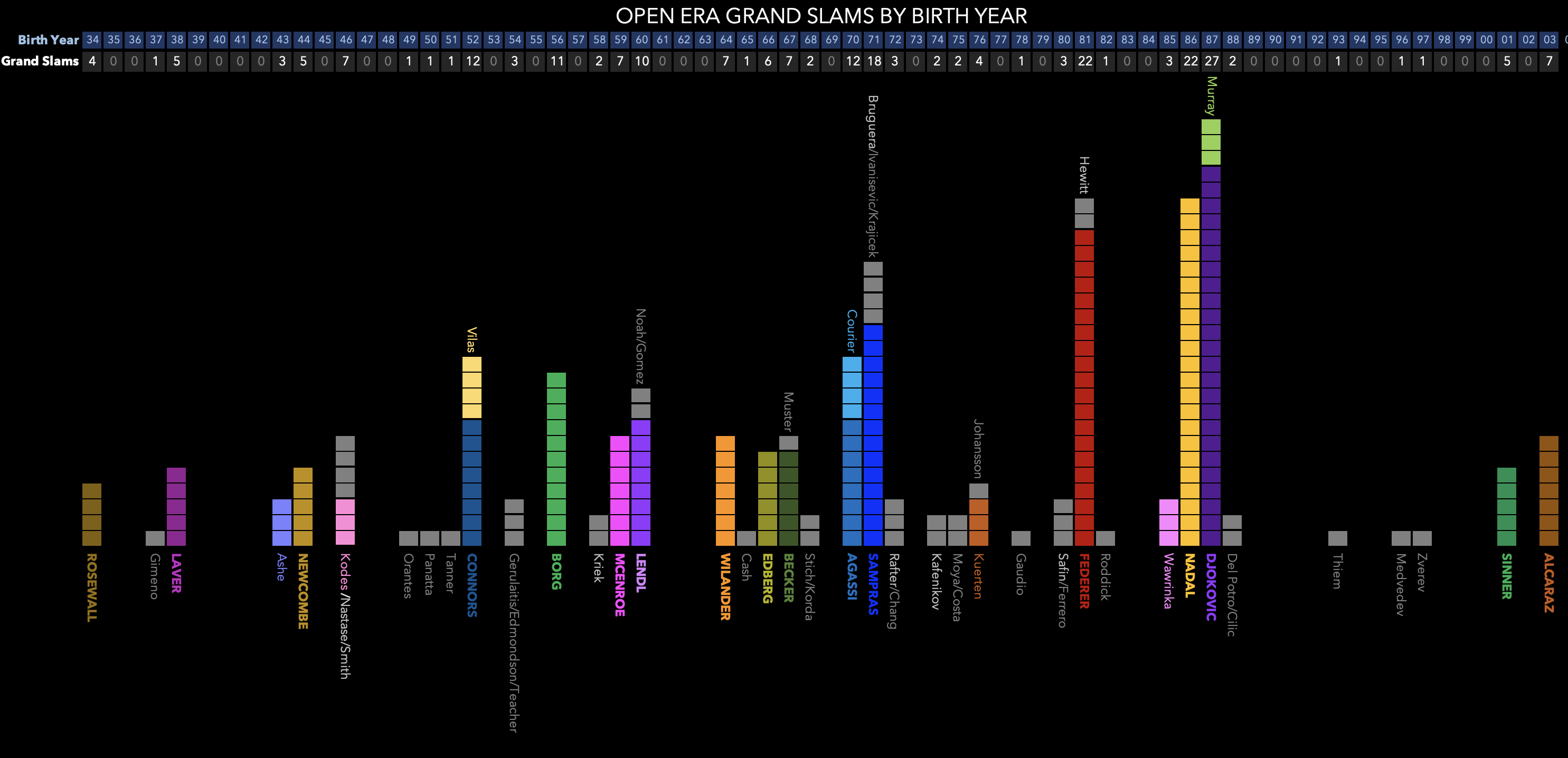
This chart illustrates the big gap between Nadal/Djokovic and Sinner/Alcaraz, in terms of Slams won by people born in certain birth years. It ties the longest gap without a single Slam winner with 1989-1992, the same as 1939-42, but more so includes a 12-year period (1989-2000) in which only three Slam titles came from people born in those years.
Chances are that Sincaraz won't be helped in quite that way.
BORG 10 (1 more the day after turning 25)
NADAL 9 (won his 10th two days after turning 25, and 13 more)
FEDERER 8 (won 12 more)
WILANDER 7 (no more)
SAMPRAS 7 (won 7 more)
ALCARAZ 7 (still has six remaining Slam tournaments before turning 25)
BECKER 5 (won 1 more)
DJOKOVIC 5 (won 19 more)
SINNER 5
Absent among players who eventually won 5 or more are Connors (4), Edberg (4), and Agassi (3). Laver and Newcombe also won 5 Slams in the Open Era; Newcombe won 2 before turning 25, both in the amateur era. Laver won 6 amateur Slams before turning 25 and 5 Open Era Slams after, with a bunch of Pro Slams in-between.
Of particular note, of the eight previous players other than Sincaraz, five of them won at least as many after turning 25 as before. Only Borg, Wilander, and Becker didn't. This doesn't mean Sinner and Alcaraz will definitely double (or more) their Slam count, but that it is likely based on historical precedents.
And of course Carlos has six more to go to add to his total, with a chance of surpassing Borg. But he'd have to win the majority of the next six to do that, and half to tie Borg.
Anyhow, who knows how many they'll both eventually win. That question depends upon two intersecting factors:
- How they age - both in terms of decline from peak level, but also health.
- Who arises in their wake.
The second factor is also crucial: The Big Three were followed by two particularly weak generations, with no "great" players born after Novak in 1987 until Jannik in 2001. That's a 14-year gap of greats. Or we can get a visual:
This chart illustrates the big gap between Nadal/Djokovic and Sinner/Alcaraz, in terms of Slams won by people born in certain birth years. It ties the longest gap without a single Slam winner with 1989-1992, the same as 1939-42, but more so includes a 12-year period (1989-2000) in which only three Slam titles came from people born in those years.
Chances are that Sincaraz won't be helped in quite that way.


