Kieran
The GOAT
I wouldn’t ask it, I’m a thigh man myself…If someone told you, “My neighbor had gender dysphoria, got surgery, and now has huge tits.”
How would you complete this question: “What size bra does [he/she/they] wear?”


I wouldn’t ask it, I’m a thigh man myself…If someone told you, “My neighbor had gender dysphoria, got surgery, and now has huge tits.”
How would you complete this question: “What size bra does [he/she/they] wear?”

I wouldn’t ask it, I’m a thigh man myself…

very good point I hadn't considered. My pronouns are I/me. I would never refer to myself as he/him. Who speaks of themselves in the 3rd person??It’s a great question because as you know, they’re still basically a man who underwent surgery. And people with gender dysphoria often accept that although they’ve had the surgery, they’re still the gender they were born with. The surgery just helps them to cope better with gender dysphoria.
My thinking on what we call trans people is simple: since everyone (more or less) agrees on the biology, then we should proceed on that basis. A biological male? Then that’s a man. The burden of accepting their “reality” shouldn’t be placed on me. That they “identify as a woman” is up to them, if that’s how they see themselves.
Of course, with somebody who is suffering with gender dysphoria, I have no issue with calling them by what they want to be. I’m not petty. If it helps them, then I’ll be happy to. But if somebody is enforcing modern gender ideology? That’s a different thing.
With regards to pronouns, I think this is the most ridiculous issue of all. What are my pronouns? They are obviously “I” and “me”. I don’t refer to myself as “He” or “him.” I’m not a deluded narcissist, thinking of myself in the third person. How others refer to me, well they can see I’m a man, but what they say behind my back, I don’t really care. I think that the fact that this has become “an issue” is a sign of the times. Hugely egotistical people identifying as “look at me,” as Douglas Murray put it. I see it in the health food store in town, the staff have their pronoun badges. Some aren’t wearing them, but I’m tempted to ask the ones who are wearing them, “can she help me finding chicory?” When they ask me who I’m referring to, I’ll act dumb and point at the badge..
Narcissists, mainly. And people who forget who they are when they stare at themselves in the mirror.very good point I hadn't considered. My pronouns are I/me. I would never refer to myself as he/him. Who speaks of themselves in the 3rd person??
It depends on the person. Generally I’d think it a crass conversation to have. If I suspect they’re a pronoun warrior, then I’d ignore them completely, though with a smile…FWIW, I would ask “What size bra does she wear?” — but I also know that biologically/genetically she is still male, albeit modified, even though I know there are people who would disagree with me.
Donald Trump.very good point I hadn't considered. My pronouns are I/me. I would never refer to myself as he/him. Who speaks of themselves in the 3rd person??
I don’t need to say anything
Rowling has funded and designed a new, women-only sexual violence support service, Beira’s Place, which opens today. “I founded Beira’s Place to provide what I believe is currently an unmet need for women in the Lothians area,” the author said this weekend. “As a survivor of sexual assault myself, I know how important it is that survivors have the option of women-centred and women-delivered care at such a vulnerable time. Beira’s Place will offer an increase in capacity for services in the area and will, I hope, enable more women to process and recover from their trauma.”
Edinburgh’s Rape Crisis Centre (ERCC) advocates on behalf of men who identify as women as well as actual women. And in May 2021, trans-identified Mridul Wadhwa was appointed chief executive of ERCC despite this being a job that was advertised as only for a woman. Three months after being appointed, Wadhwa referred in a podcast to female rape victims who did not want to deal with men in a support service as “bigoted people”. Wadhwa had the audacity to suggest that these women should “reframe their trauma”.


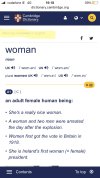
Cambridge Dictionary now joins Marriam-Webster as another dictionary that’s no longer fit for purpose:
“an adult who lives and identifies as female though they may have been said to have a different sex at birth”
Cambridge Dictionary now joins Marriam-Webster as another dictionary that’s no longer fit for purpose:
“an adult who lives and identifies as female though they may have been said to have a different sex at birth”
I don’t need to say anything
A woman is not “An adult who lives and identifies as female though they may have been said to have a different sex at birth.”To be clear, though, that’s only one of the definitions — the one which would be applicable to someone with gender dysphoria who transitions. Here’s the full page, with multiple definitions:
View attachment 7386
View attachment 7387
The dictionary is going to reflect a word’s usage — that’s its purpose. It documents how words have been used. If the word “woman” is being used in the context of “an adult who lives and identifies as female,” etc., then they’re going to include that among the other definitions. “Cat” was once used to describe a feline; in the mid to late 20th century people began using it to describe people: “he’s a real cool cat”. A dictionary isn’t going to omit an entry for “cat” being used to describe a person simply because the word had historically been used to describe a feline.A woman is not “An adult who lives and identifies as female though they may have been said to have a different sex at birth.”
This is why the dictionary is unreliable. They’re passing faddish gender politics as being definitively true. An adult who was born to a different sex than female is a man. Anyone unsuspectingly reading this might think there’s some truth to it. The dictionary has given a stamp of approval for bad ideas. This is why I worry for the youth - they’re growing up in a world which has normalised a culture where lies are being taught as truth…
The dictionary is showing us the meaning of the word, “woman”, then below that is giving us sentences which reflect the words usage. One of the meanings of the word “woman” - according to the dictionary - is that a woman is “an adult who lives and identifies as female though they may have been said to have a different sex at birth.”The dictionary is going to reflect a word’s usage — that’s its purpose. It documents how words have been used. If the word “woman” is being used in the context of “an adult who lives and identifies as female,” etc., then they’re going to include that among the other definitions. “Cat” was once used to describe a feline; in the mid to late 20th century people began using it to describe people: “he’s a real cool cat”. A dictionary isn’t going to omit an entry for “cat” being used to describe a person simply because the word had historically been used to describe a feline.
The dictionary is showing us the meaning of the word, “woman”, then below that is giving us sentences which reflect the words usage. One of the meanings of the word “woman” - according to the dictionary - is that a woman is “an adult who lives and identifies as female though they may have been said to have a different sex at birth.”
This is wrong, because that’s not the meaning of the word woman, regardless of how some people think it is. But there will be people who are fooled into thinking that because it’s in the dictionary, it must be true…
Its usage might be wrong, is the point. That’s what a dictionary is there to clarify - what words actually mean. And the dictionary clearly says that it’s showing us “the meaning of the word woman.” This is a different thing that showing us its usage. A dictionary ought to be precise in defining a word, then clear as to how it’s being used, or misused. It’s misleading when it tells us that a “meaning of the word woman” includes men who identify as a woman…But that’s just it: the word “woman” has multiple usages, therefore multiple entries. You might as well be saying the word “bad” only refers to something which isn’t good — that’s the meaning of bad. Yet we know it has been used to mean the complete opposite, therefore you’re going to find multiple entries under the same word, even if you say “this is wrong, because that’s not the meaning of the word” bad.
A dictionary is a mirror of a language’s usage. It’s not a legal document.